The role of volcanoes and ice in Arthur's Seat history
Arthur's Seat history begins with volcanic activity, followed by erosion and the later shaping of the landscape by glaciers. Erosion wore away the outer cone and exposed rocks from different parts of the volcano, including lava, ash and material that filled its vents. The outline of the hill today reflects both what the volcano left behind and what later processes removed.
At St Anthony's Chapel, dark basalt lies above volcanic ash. The two layers help tell the difference between material deposited by an explosive eruption and rock left by flowing lava. You can make the chapel area part of the walk from Holyrood towards the summit, or see the ruins from St Margaret's Loch below.

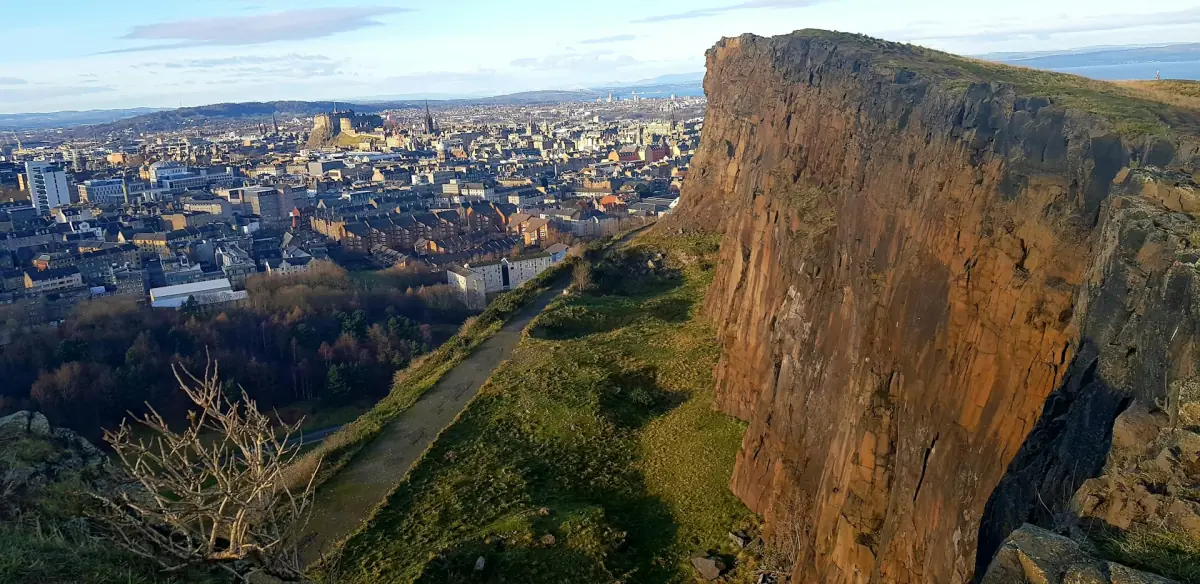
Salisbury Crags and James Hutton's observation
Salisbury Crags formed when molten rock entered older sedimentary rock and cooled as a horizontal sheet of dolerite. Geologists call this structure a sill. The Crags formed later than the volcanic rocks of the summit. In the 18th century, James Hutton recognised at Salisbury Crags that the molten material had intruded into rock that was already there.
The cliff face and the hilltop thus tell different parts of the geological story. For a walk with a view of the Crags, the Holyrood Park guide distinguishes the upper path from the Radical Road and covers access around the cliff.
Our pick: stories on the walk
A local guide discusses Scottish history and folklore on this Arthur's Seat walk.
Hand-picked tours, booked through GetYourGuide. Prices are indicative starting prices in British pounds (as of November 2026). Tap a tour for live availability and the current price in your currency.

Scottish history and folklore on a guided walk
Choose a daytime or evening walk from the Scottish Parliament at Horse Wynd. The two-and-a-half-hour walk covers Scottish history, folklore and local plants with a local guide. The evening option includes a headlamp for the descent.
Bronze Age life and the founding of Holyrood Abbey
Holyrood Park contains traces of Bronze Age farming, and a hoard of Late Bronze Age weapons was discovered in Duddingston Loch in 1778. Stone Age finds also show that people used this landscape long before the abbey and the later park works. The hoard and the evidence of farming point to different kinds of activity around the hill.
David I founded Holyrood Abbey in 1128. A legend links its founding to an encounter with a stag and a vision of a cross. St Anthony's Chapel is a separate ruin above St Margaret's Loch. The chapel had repairs in 1426 and has stood in ruins since at least the 18th century.
The Radical Road, quarrying and the Victorian park
The Radical Road was built in 1826 by unemployed weavers under Walter Scott's direction, and intensive quarrying ended in 1831. The road runs beneath Salisbury Crags, bringing together the story of the people who worked in the park and the rock that shaped their work.
Prince Albert's reshaping of Holyrood Park began in the 1840s. St Margaret's Loch and Dunsapie Loch were created in the 1850s, adding two bodies of water to a landscape whose hills had already been shaped by erosion and ice. To start with the chapel and St Margaret's Loch, find the walking approach from Holyrood.
Arthur's Seat history FAQ
How did Arthur's Seat get its present shape?
Arthur's Seat took shape through volcanic activity, erosion and later glacial action. Erosion stripped away the outer volcanic cone and exposed lava, ash and material from the vents. Glaciers later shaped the landscape. The basalt over ash near St Anthony's Chapel shows two kinds of volcanic deposit.
When was St Anthony's Chapel repaired?
1426 is the year of a repair at St Anthony's Chapel. The chapel has been in ruins since at least the 18th century. In Holyrood Park today you can look up from St Margaret's Loch towards the rocky ledge where the surviving stone walls stand.
Which loch lies below St Anthony's Chapel?
St Margaret's Loch lies below St Anthony's Chapel, which stands on a rocky ledge above the water. The loch was created in the 1850s, as was Dunsapie Loch on the east side of the hill. You can see the chapel ruins from St Margaret's Loch.